
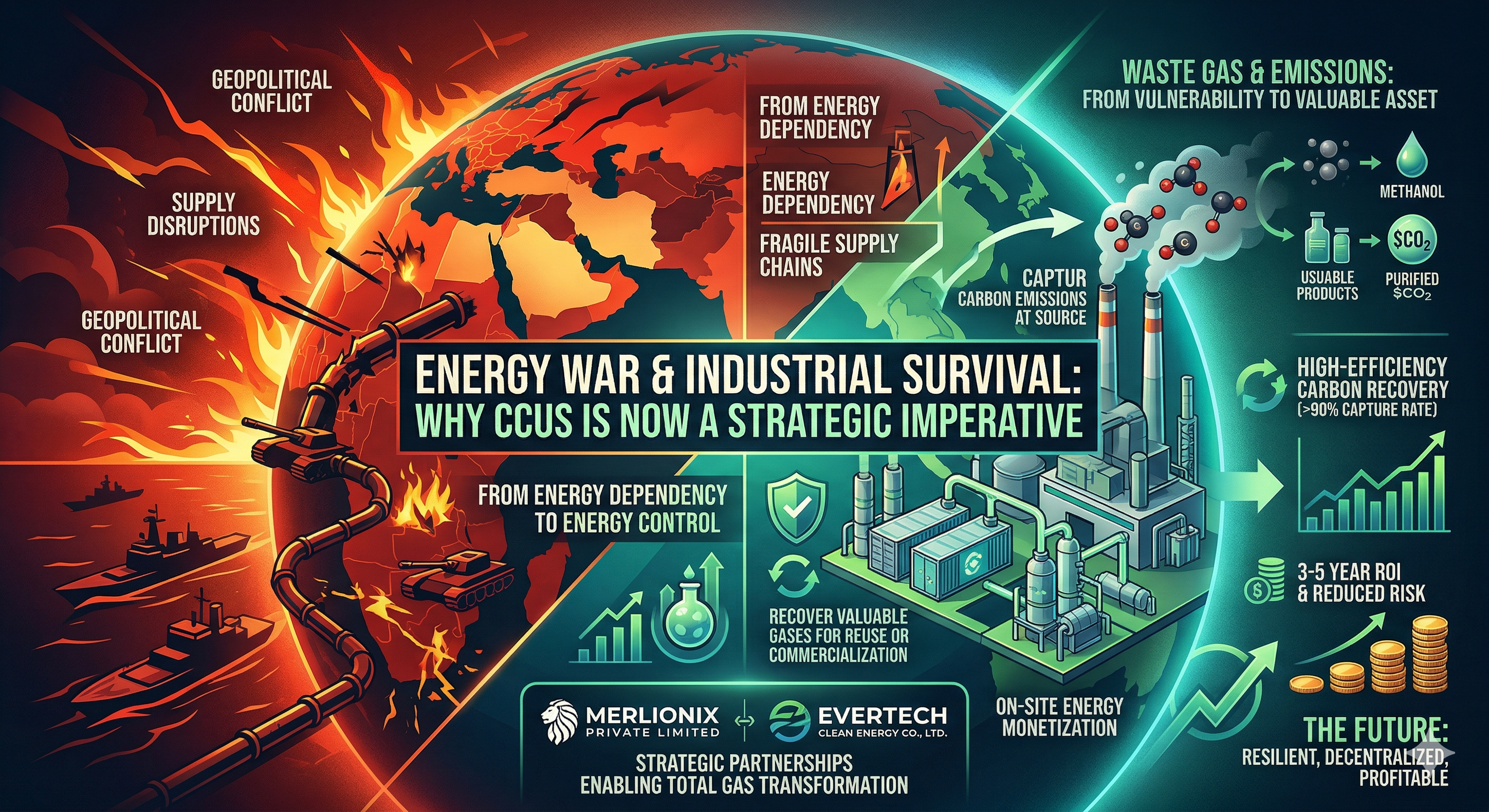
Energy War & Industrial Survival: Why CCUS is Now a Strategic Imperative
The global energy landscape is undergoing a profound transformation—not driven solely by climate goals, but by geopolitical conflict. The escalating tensions between the United States and Iran, alongside ongoing instability in the Middle East, have made one reality clear: energy is no longer just an economic resource—it is a strategic weapon.
For decades, industries have relied on centralized supply chains and cross-border energy dependencies. However, in times of conflict, these systems become fragile. Disruptions to oil routes, sanctions, and volatile pricing have exposed critical weaknesses across global industries—from petrochemicals to power generation.
Today, the question is no longer “How do we decarbonize?”
It is “How do we survive and remain competitive in an unstable world?”
From Energy Dependency to Energy Control
As global conflicts intensify, industrial players are rapidly shifting their focus toward energy independence and operational resilience. One of the most overlooked opportunities lies within their own facilities: waste gas and carbon emissions.
Historically, flared gas was treated as a byproduct—burned, discarded, and forgotten. In today’s environment, that approach represents not only environmental loss, but also economic inefficiency and strategic vulnerability.
Through advanced Carbon Capture, Utilization, and Storage (CCUS) technologies, industries can now:
- Capture carbon emissions directly at the source
- Recover valuable gases for reuse or commercialization
- Reduce dependence on external energy markets
- Create new revenue streams from previously wasted resources
The Role of Merlionix & EverTech in a New Energy Era
Strategic partnerships such as Merlionix Private Limited and EverTech Clean Energy Co., Ltd. are at the forefront of this transformation.
By combining regional expertise with advanced engineering capabilities, these organizations are enabling industries to transition toward total gas transformation—a model where no gas is wasted, and every emission becomes a potential asset.
Key advantages include:
1. Rapid Deployment (“Sino-Speed” Implementation)
Unlike traditional large-scale projects that require years of development, modular CCUS systems can be deployed quickly—making them ideal for industries operating in uncertain or high-risk environments.
2. High-Efficiency Carbon Recovery
With advanced composite amine technology, facilities can achieve carbon capture rates exceeding 90%, with high-purity output suitable for industrial and food-grade applications.
3. On-Site Energy Monetization
Recovered gases can be reused within operations or sold into the market, turning operational costs into profit centers.
Conflict-Driven Opportunity: Turning Risk into ROI
While global conflict introduces uncertainty, it also accelerates innovation. Companies that act early are not only mitigating risk—they are gaining a competitive advantage.
In many cases, CCUS implementation delivers:
- Return on Investment (ROI) within 3 to 5 years
- Reduced exposure to volatile energy pricing
- Compliance with tightening environmental regulations
- Stronger positioning in global supply chains
In this context, decarbonization is no longer a compliance exercise—it is a core business strategy.
The Future: Resilient, Decentralized, and Profitable
As geopolitical tensions continue to reshape global markets, the industries that thrive will be those that adapt quickly.
The integration of CCUS and gas recovery solutions represents more than a technological shift—it signals a new industrial paradigm:
- Decentralized energy systems
- Circular resource utilization
- Resilient and self-sustaining operations
Through the combined strengths of Merlionix and EverTech, the path forward is clear: transform emissions into assets, reduce dependency, and build a future where sustainability and profitability go hand in hand.
In an era defined by energy conflict, control over your resources is no longer optional—it is essential.