
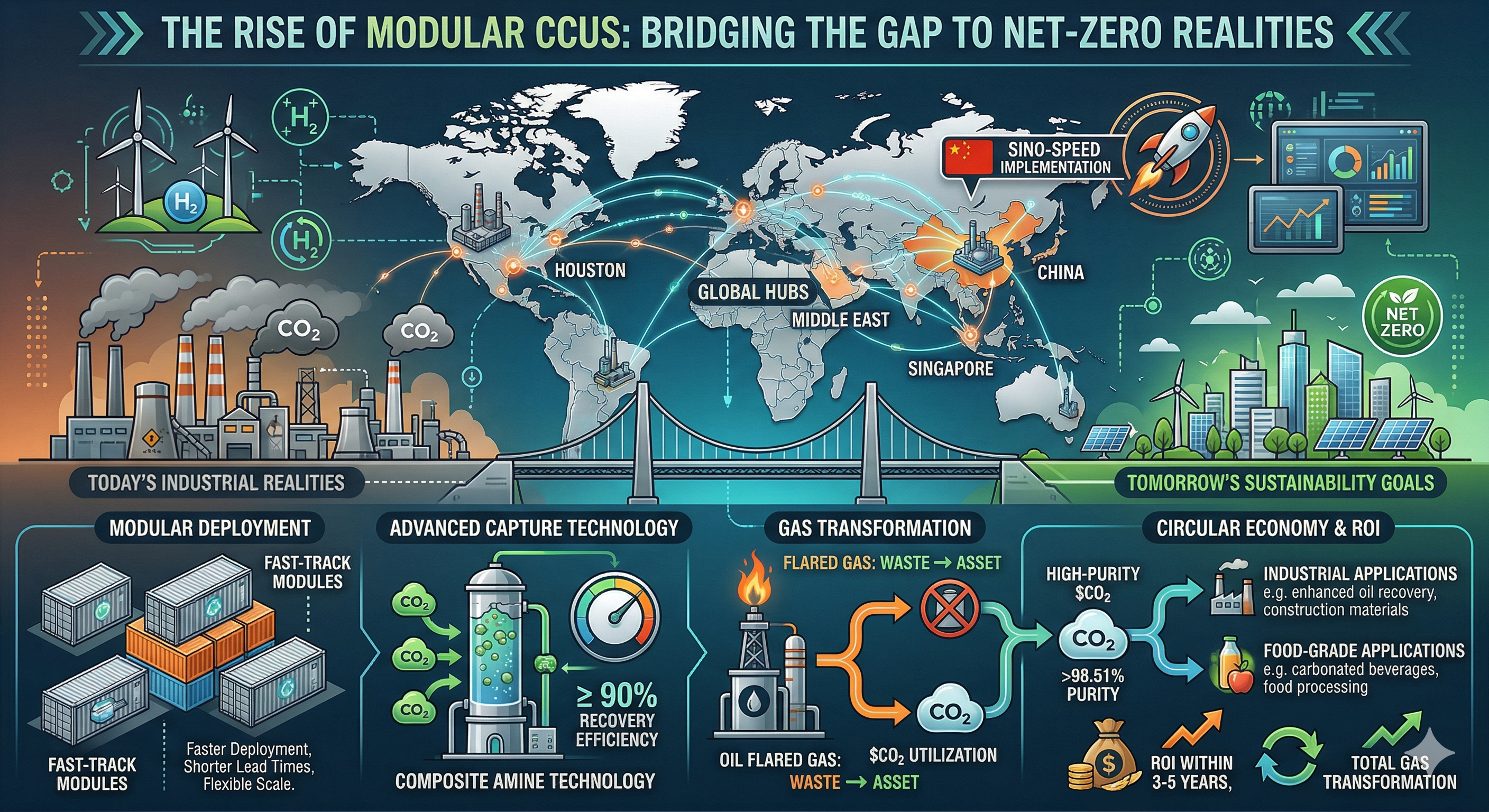
The Rise of Modular CCUS: Bridging the Gap to Net-Zero Realities
Global Hubs — As industrial sectors face increasing pressure to meet net-zero mandates, the demand for efficient Carbon Capture, Utilization, and Storage (CCUS) has shifted from a "future goal" to an "immediate necessity". Traditional large-scale carbon capture projects often face long lead times, but a new wave of "Sino-Speed" modular implementations is changing the landscape by allowing for faster deployment.
Recent global trends show that industries like coal mining, steel, and petrochemicals are no longer viewing flared gas as waste, but as a monetizable asset. By utilizing advanced Composite Amine Technology, companies can now achieve carbon dioxide (CO2) recovery efficiencies of more than 90 percent. This high-purity output, exceeding 98.5 percent, is increasingly being redirected for industrial and food-grade applications, effectively turning an environmental liability into a circular economy success story.
"We are bridging the gap between today’s industrial realities and tomorrow's sustainability goals," according to the strategic vision for gas transformation. With global hubs expanding from Singapore to Houston and the Middle East, the transition toward total gas transformation is accelerating, proving that decarbonization can offer a strong return on investment (ROI) within 3 to 5 years.